
 Send Inquiry
Guidance on Lifting Operations in Construction When Using Excavators
Contents
The main design purpose of an excavator in construction is construction excavation, and it’s usually not used for lifting tasks. However, in certain situations, with proper preparation and safety measures, it can be used to perform limited lifting operations. Below is a simple guide for using an excavator for lifting work:
Preparation
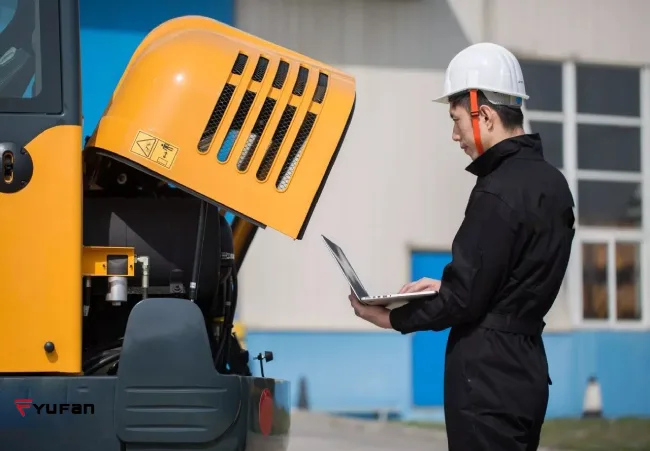
Check the excavator: Make sure all parts of the construction excavator—including the engine, hydraulic system, tracks, boom, and bucket—are working properly, with no damage or signs of malfunction. Pay extra attention to the hydraulic lines and joints related to lifting to ensure there are no leaks.
Choose the right attachment: Select suitable lifting attachments based on the object being lifted, such as a special lifting hook or grab, and make sure they are securely connected to the excavator.
Assess the work area: Carefully inspect the site, remove any obstacles, and ensure there is enough space to safely carry out the lifting operation.
Lifting Steps
Position the excavator: Park the construction excavator close to the object to be lifted, making sure the boom can easily reach over it. Adjust the tracks and angle if needed to ensure stability.
Connect the lifting attachment to the object: Use proper connecting tools like chains or steel cables to firmly attach the lifting accessory to the object. Make sure the weight is evenly distributed to avoid tilting or swinging during lifting.
Lift slowly: Carefully operate the boom of the construction site excavator to lift the object slowly. Keep an eye on both the object and how the excavator responds. Avoid sudden movements—lift at a steady, controlled speed.
Move and place the object: Once lifted, slowly move the object to the desired location. Keep the boom stable during the move, watch out for nearby people and obstacles, and make sure the path is clear. Once at the destination, gently lower the object and make sure it’s secure before disconnecting.
DOS AND DON’TS
Follow operating procedures: Always follow the excavator’s manual and relevant safety rules. Never operate against regulations.
Know the weight limits: Understand the excavator’s lifting capacity and never lift more than the rated weight.
Set up a safety zone: Mark off the lifting area clearly, and keep unrelated people out to prevent accidents.
Use trained professionals: Lifting should only be done by trained and certified excavator operators. It’s also best to have a designated person on site for supervision and guidance, using standard hand signals to communicate with the operator.
Do a risk assessment: Before starting work, think through possible risks and have emergency plans ready. Be prepared for issues like falling objects or excavator tipping.
Excavator Lifting Capacity
| Excavator | Lifting Capacity Suggestion |
| 1 ton mini excavator | ⭐ |
| 5 ton excavator | ⭐⭐ |
| 8 ton excavator | ⭐⭐⭐ |
| 10 tonne excavator | ⭐⭐⭐⭐ |
| 15 ton excavator | ⭐⭐⭐⭐⭐ |
| 20 tonne excavator | ⭐⭐⭐⭐⭐⭐ |
Generally, the heavier the machine, the more powerful its hydraulic system and the stronger its structure. As a result, it can lift heavier loads. For example, medium excavators typically weigh between 15 to 35 tons. They are widely used and offer relatively high lifting capacity. In contrast, ultra-large mining excavators (over 100 tons) provide extremely strong lifting capacity and high work efficiency.
However, lifting capacity is not only affected by machine weight. It is also closely related to the performance of the hydraulic system, boom length, counterweight design, and working radius.
Key Factors That Affect Excavator’s Lifting Operations Performance

The lifting capacity of different mini excavator models varies mainly in the following aspects:
Machine Design and Hydraulic System
Lifting ability depends heavily on the efficiency of the hydraulic pump and cylinders. Models with more advanced design and stronger hydraulics can lift more and offer better stability during lifting.
Boom Length and Arm Configuration
Longer booms reduce lifting capacity due to the lever effect. Since boom length and shape vary by model, lifting performance at different radii also differs. Operators must use load charts to lift safely.
Engine Power and Machine Weight
Machines with higher power and greater weight usually lift more. For example, small excavators typically range from 13.4 to 55 horsepower. The smallest models can lift about 1,760 lbs (around 800 kg), while larger ones can lift up to 20,000 lbs (around 9 tons). The difference is significant.
Counterweight and Stability Design
The size and position of the counterweight affect balance and lifting safety. Models with different counterweight setups have different safe load limits. A well-designed counterweight improves both stability and safety.
Working Radius and Bucket Position
The farther the load is from the machine, the lower the lifting capacity. Each model has a specific load capacity curve. As the radius or bucket height changes, the lifting capacity also changes.

Posted by Isabel leave words
Thanks for reading. I hope my article helps. Please leave a comment down below. You may also contact YUFAN online customer representative for any further inquiries.
 English
 Arabic
 Chinese (Simplified)
 Dutch
Dutch English
 French
 Italian
 Portuguese
 Russian
 Spanish
Leave a Reply